Interest on late maintenance payments: what housing societies can charge
HousingMS Team · 9 Oct 2026 · 2 min read
Unpaid maintenance is the most common money problem in a housing society. One or two defaulters quickly turn into ten if there is no consequence for paying late. Most societies handle this with interest on late payment — but it has to be fair, consistent and within the rules.
What the bye-laws usually allow
Many co-operative housing societies (for example in Maharashtra) follow model bye-laws that allow the society to charge simple interest on dues not paid by the due date, up to 21% per annum, at a rate decided by the general body. The key words:
- Simple interest, not compound — interest is calculated on the unpaid amount only.
- Up to 21% a year — your general body can choose a lower rate.
- It applies to dues that remain unpaid after the due date you have fixed.
Always check your own society's registered bye-laws and the resolutions passed by your general body.
Three ways to handle late payment
- No penalty — overdue bills are simply flagged. Works for small, close-knit societies.
- Interest per year — fair and proportional: a few days late costs a little, months late costs more.
- A fixed late fee — simple to explain, e.g. ₹200 once the bill is late.
Give a grace period
A short grace period (for example 5–10 days after the due date) avoids penalising people for bank holidays or salary dates, and reduces arguments at the AGM.
A worked example
A ₹3,000 bill is due on the 10th and paid 30 days late. At 21% per annum:
₹3,000 × 21% × 30 / 365 = ₹51.78
That is enough to encourage prompt payment without feeling punitive.
Automate it so nobody has to argue
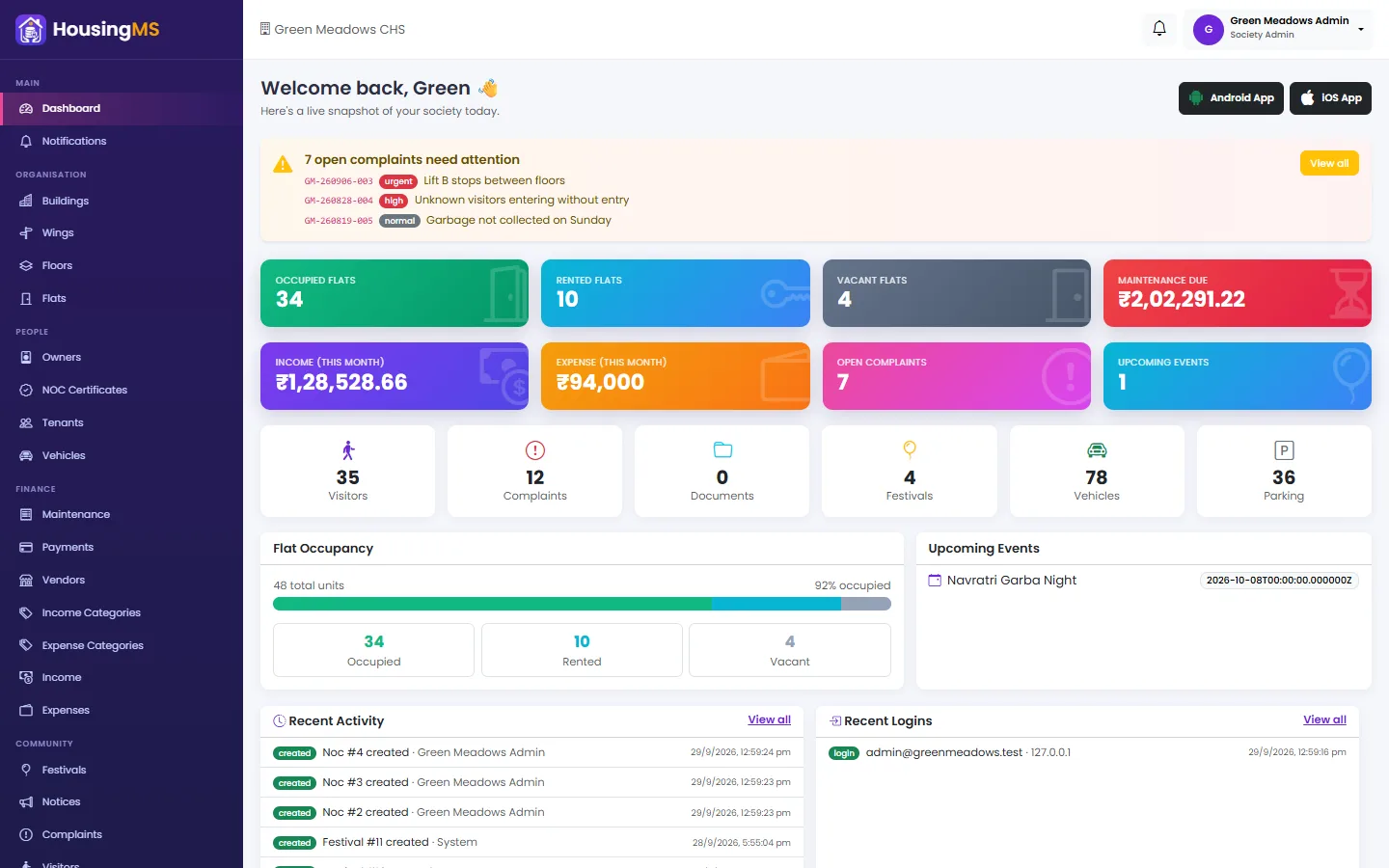
Interest calculated by hand invites disputes. In HousingMS the committee picks no penalty, yearly interest or a fixed late fee, sets the due day and grace days, and the penalty is applied automatically every night to unpaid bills. Residents see exactly how it was calculated on their ledger, and the same rule applies to every flat.