
Sinking fund and repair fund in housing societies: rules, rates and a worked example
HousingMS Team · 3 Nov 2026 · 5 min read
Two lines on almost every maintenance bill in a co-operative housing society cause more questions than all the others put together: Sinking Fund and Repair & Maintenance Fund. Members ask why they pay them, committees ask how much to charge, and new treasurers ask where the money is supposed to go. This guide answers all three.
The two funds in one sentence each
- Sinking fund: a long-term reserve for the day the building needs major structural work or reconstruction. It is collected for decades and spent rarely.
- Repairs and maintenance fund: money for the regular repairs a building needs every few years, such as waterproofing, painting, plumbing lines and plaster work.
Both are owners' contributions. They are different from the monthly service charges (security, housekeeping, electricity, water), which pay for running the society this month.
What rates do societies use?
In Maharashtra, most co-operative housing societies follow the model bye-laws. Under those, the commonly applied rates are:
- Sinking fund: at least 0.25% of the construction cost of each flat per year, excluding the cost of land.
- Repairs and maintenance fund: about 0.75% of the construction cost of each flat per year.
The general body decides the actual rates within the bye-laws, and the construction cost used is the one approved for the society. Some societies, with general body approval, fix the repair fund as a simple rate per square foot instead. Always check your society's registered bye-laws and the resolutions passed at your general body meetings before changing a rate.
Worked example: one flat
Take a 650 sq ft flat in a building whose construction cost is ₹3,200 per sq ft.
- Construction cost of the flat: 650 × ₹3,200 = ₹20,80,000
- Sinking fund at 0.25% a year: ₹20,80,000 × 0.25% = ₹5,200 a year, which is ₹433.33 a month
- Repair fund at 0.75% of construction cost: ₹15,600 a year, which is ₹1,300 a month
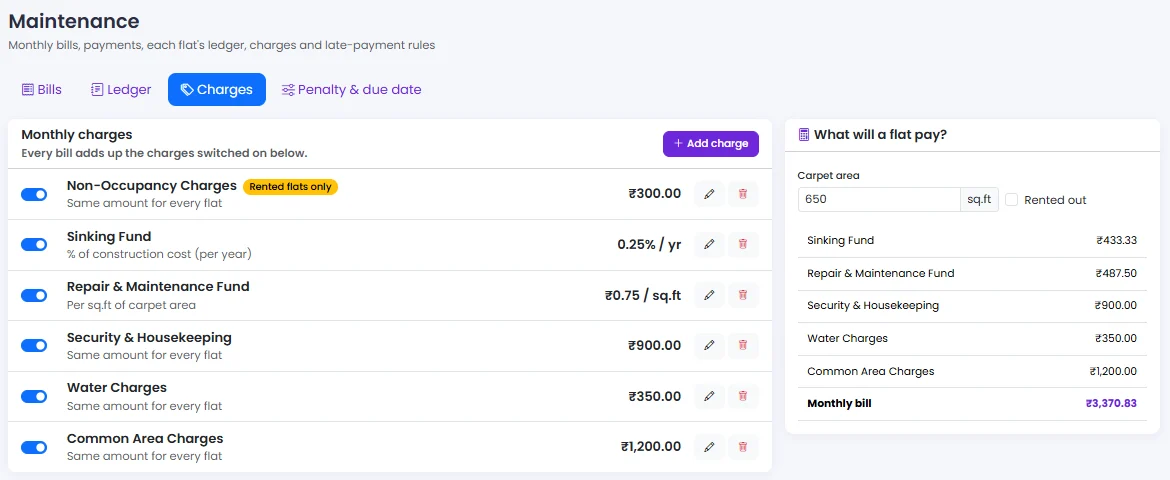
The society in our screenshot charges its repair fund as ₹0.75 per sq ft per month instead, which for this flat is ₹487.50 a month. Both approaches are common. What matters is that the general body approved the method and every flat is charged the same way.
Worked example: the whole society
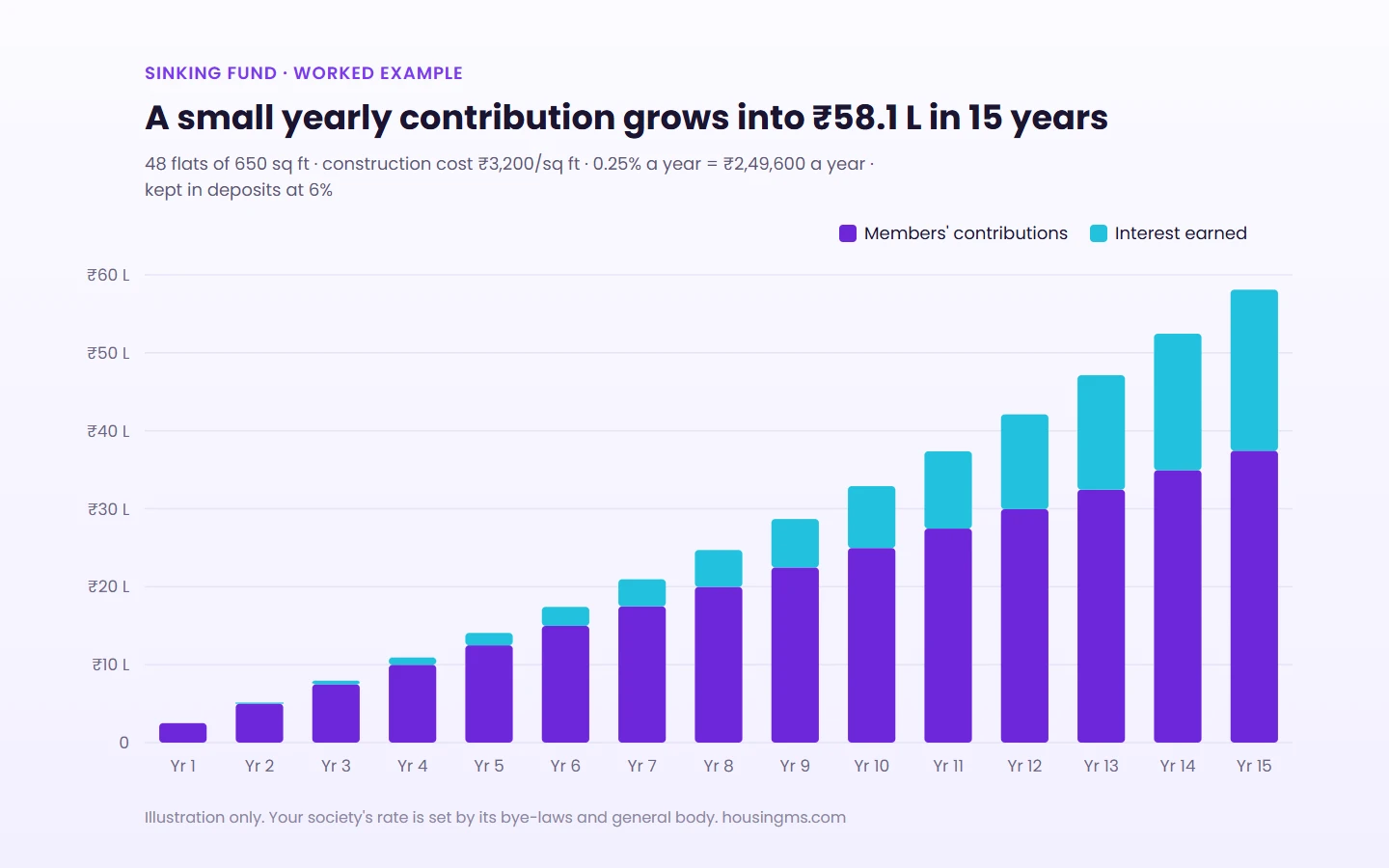
Now take 48 such flats. The sinking fund collects 48 × ₹5,200 = ₹2,49,600 a year. Kept in fixed deposits at around 6%, the reserve grows to roughly ₹58 lakh after 15 years, of which about ₹21 lakh is interest. That is the point of a sinking fund: a contribution members barely notice each month becomes the money that pays for a structural repair nobody wants to fund with a sudden special levy.
Where the money must go
- Keep the sinking fund separate. Most bye-laws expect it to be invested separately, typically in fixed deposits with a co-operative or scheduled bank, and not mixed with day-to-day funds.
- Add the interest to the fund. Interest earned on sinking fund deposits belongs to the sinking fund, not to general income.
- Spend only with general body approval. The sinking fund is meant for major structural repairs and reconstruction, and drawing on it usually needs a general body resolution. The repair fund is used for planned repair work as approved by the committee or general body.
- Show both funds clearly in the accounts. Members should be able to see the opening balance, contributions, interest, spending and closing balance of each fund every year.
Common mistakes
- Charging a flat amount to every flat. The sinking fund is linked to construction cost, so a larger flat contributes more. A single flat rate is unfair to smaller flats.
- Using the fund for running costs. Paying the security agency from the sinking fund in a tight month leaves a hole that is hard to refill.
- Never revising the construction cost. Many societies still use the cost from the year of registration. A general body can review it when building costs have risen sharply.
- Not explaining it to members. A one-line note on the bill or a short explanation at the AGM removes most of the complaints.
Setting it up in HousingMS
Under Maintenance → Charges, add the sinking fund as % of construction cost (per year) and enter the rate. The society's construction cost per sq ft is set once in society settings, and every bill works out each flat's share from its carpet area automatically. The repair fund can be a percentage too, or a rate per sq ft. The calculator on the same screen shows exactly what any flat will pay before you generate a single bill. See maintenance billing for the full list of charge types.
Frequently asked questions
Is the sinking fund refunded when a member sells the flat?
Generally no. The contribution belongs to the society and stays with the building; the new owner simply continues paying.
Do tenants pay the sinking fund?
It is an owner's contribution. Owners may recover it from tenants under their rent agreement, but the society bills the owner.
Can a society charge less than 0.25%?
Under the model bye-laws, 0.25% is the minimum for the sinking fund. A society that wants a different rate should take advice and follow its own registered bye-laws.
For the full picture of a maintenance bill, read how to calculate society maintenance charges.